Hall i’ th’ Wood.
Hall I’ th’ Wood stands in the Tonge district of Bolton. A rare surviving example of a Tudor wooden-framed house, Hall in the Wood was originally built as a half-timbered hall in 1483 by the Brownlow Family. Lawrence Brownlow being a successful clothier.
A stone North West Wing of two storeys, and built of rubble stone and mullioned windows, was added to Hall i’th’ Wood in 1591, and the Hall was subsequently extended with a stone fronted wing by the Norris Family in 1648 at the behest of Alexander Norris. Over time the hall became one of the most important buildings in the area, and noted as the home of Samuel Crompton (1753-1827).
The hall was occupied in the 16th century by the Brownlow family and through the will of Lawrence Brownlow in the next century it was occupied by the Norris family.
Christopher Norris having moved into the house in 1639 shortly after Lawrence Brownlow Junior’s death. Christopher Norris died on 22 December 1639, and his son Alexander, a Bolton based Woollen Merchant and Draper, succeeded him.
Alexander’s daughter Alice was his main beneficiary, she had married into the Starkie family, Her son Nicholas Starkie was a lawyer in Bolton and he was living at the Hall until he left it in 1697.
After this the house fell into disrepair, and was let out to farm labourers and weavers, each of whom had their own entrance.
Over time the hall became one of the most important buildings in the area, and noted as the home of Samuel Crompton (1753-1827).
Hall i’ th’ Wood had fallen into a bad state of repair when Lord Leverhulme bought it in 1898, but he restored it and presented it to the Corporation of Bolton in 1900.
The hall was restored c.1900 by Jonathan Simpson and Grayson and Ould, for Lord Leverhulme, and it may have been during this restoration or, as a letter from the curator dated Feb 1928 is quoted: “The roof timbers are badly eaten by the death watch beetle and my Committee is now taking steps to remove or strengthen some of the spars, posts etc.” it was then that the old clock frame was removed and discarded into the cellar.
Samuel Crompton (3 December 1753 – 26 June 1827)
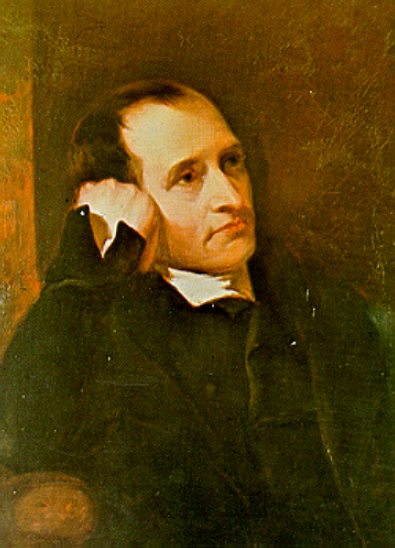
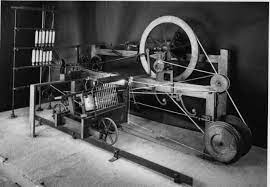
Samuel Crompton was an English inventor and pioneer of the spinning industry. Building on the work of James Hargreaves and Richard Arkwright, he invented the Spinning Mule, a machine that revolutionised the industry worldwide. The Mule was also known as the ” Hall -i’-th’- Wood Wheel or Muslin Wheel”
Crompton’s Mule
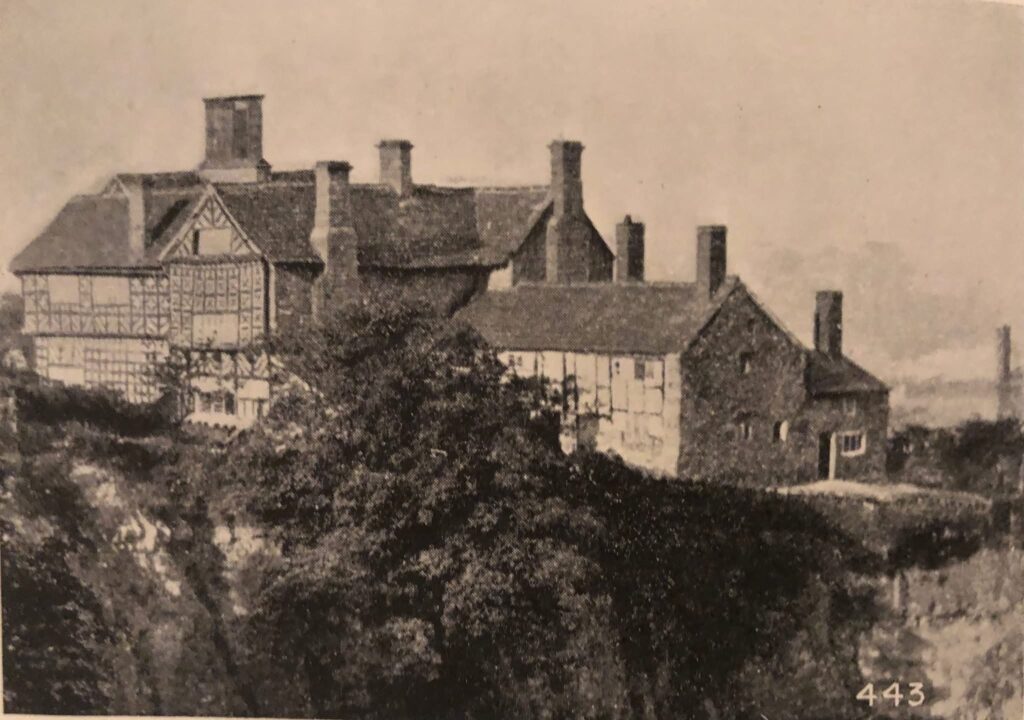
Hall I’ th’ Wood is not known for having a clock, and has never had a clock tower, or a clock face on any of its gables.
Even in the past when the Hall had a larger footprint with an extra wing towards the river, there was still no evidence of a clock being present.
Hall I’ th’ Wood, as Samuel Crompton would have known it.
Published in 1859 By Gilbert French, “The Life and Times of Samuel Crompton” notes:
The Hall-in-the-Wood lost however a great charm, and almost its right to the name, during the time Crompton resided there.
The magnificent oak and beech trees with which it was then densely surrounded were cut down; and Crompton always looked back to their removal with feelings of sorrow and regret
Just as Samuel Crompton was on the very eve of completing his first Mule in 1779, and anxiously desirous to test it by putting it to actual work, Machine-breaking Riots intervened.
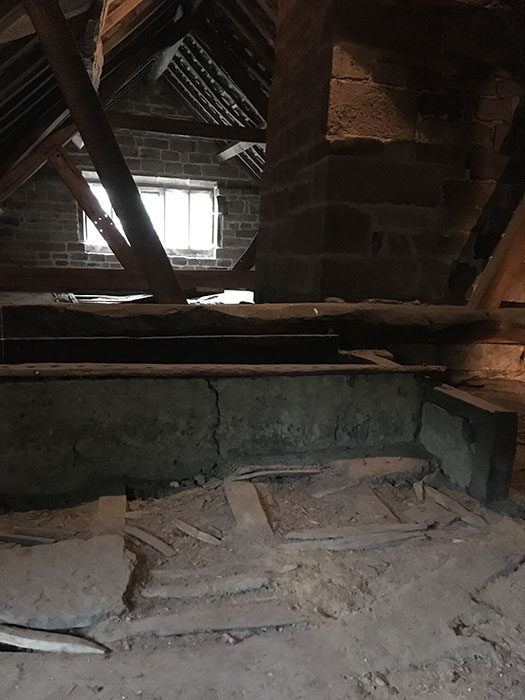
When this storm was raging Samuel took his new machine to pieces and concealed the various parts in a loft or garret near the clock in the old Hall. There they remained hid for many weeks ere he dared to put them together again. But in the course of the same year the Hall i’ th’ Wood wheel was completed, and the yarn spun upon it used for the manufacture of muslins of an extremely fine and delicate texture.
Some of the wheels and other machinery of a large clock still remain fixed to the beams in the attic of the Hall-in-the-Wood. This clock appears to have had no face ; its office was to strike the hours upon a large bell suspended under a bell-cot on the roof, which must have been heard for a considerable distance down the valley. The bell has been removed, but its position is clearly indicated.
The Bell Cot in the roof of the central wing of the old house.
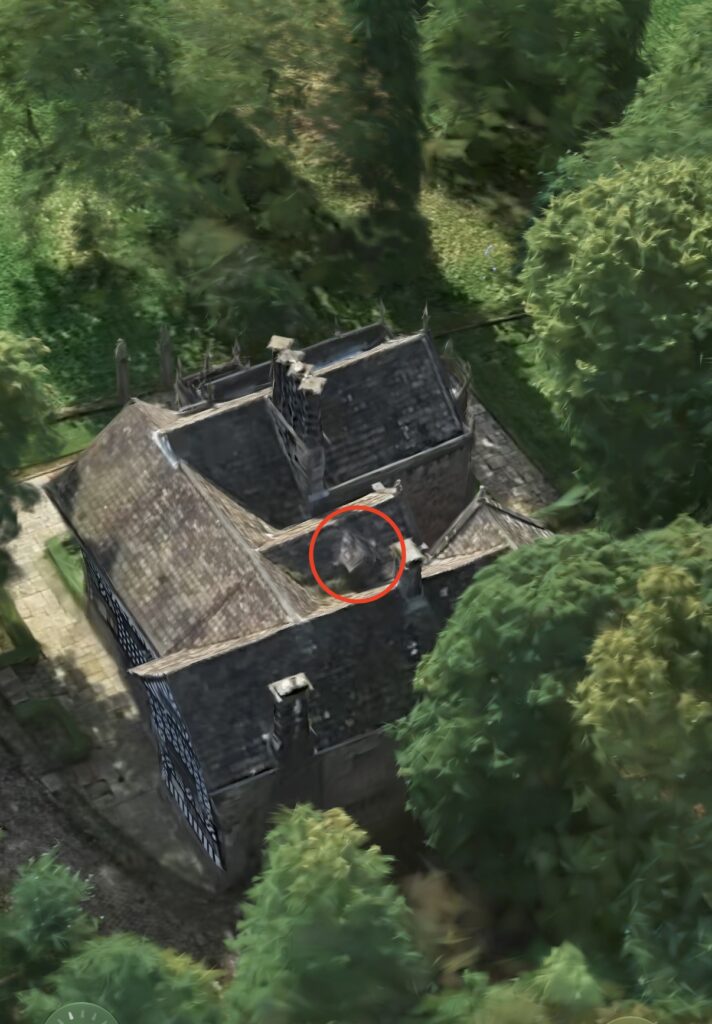
Looking at the roof line the probable location of the Bell Cot, becomes evident, on the short central roof, opposite to the single chimney, as does its concealed nature from onlookers, making it the perfect place for Crompton to secrete his dis-assembled Spinning Mule.
The Attic
The clock.
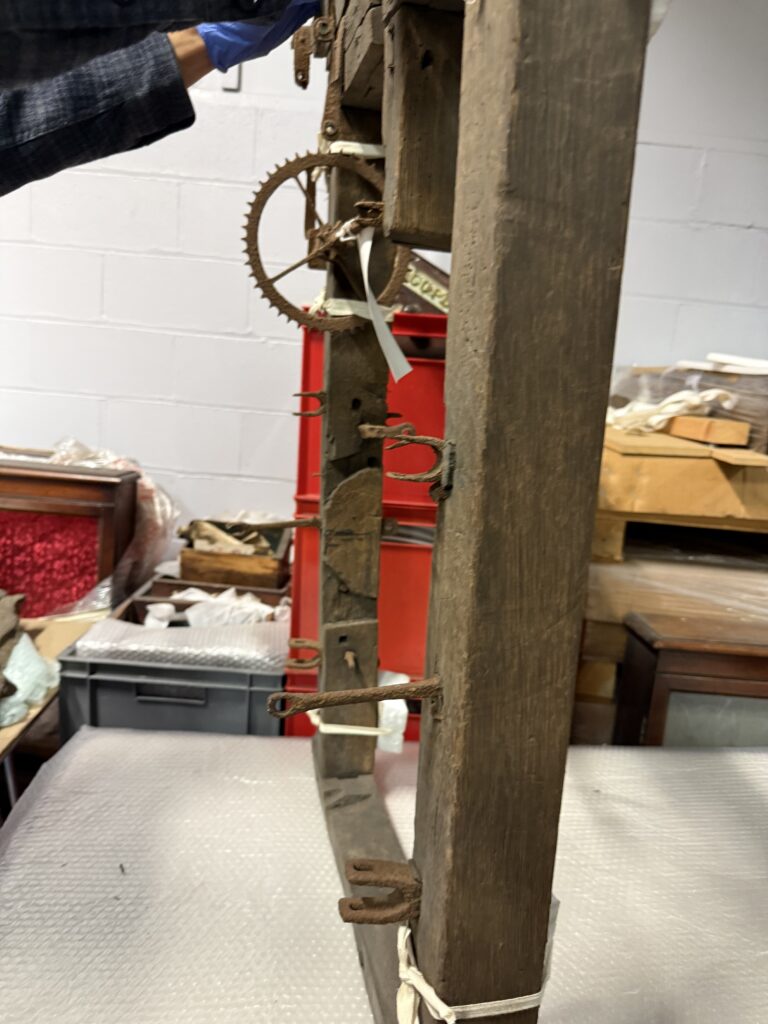
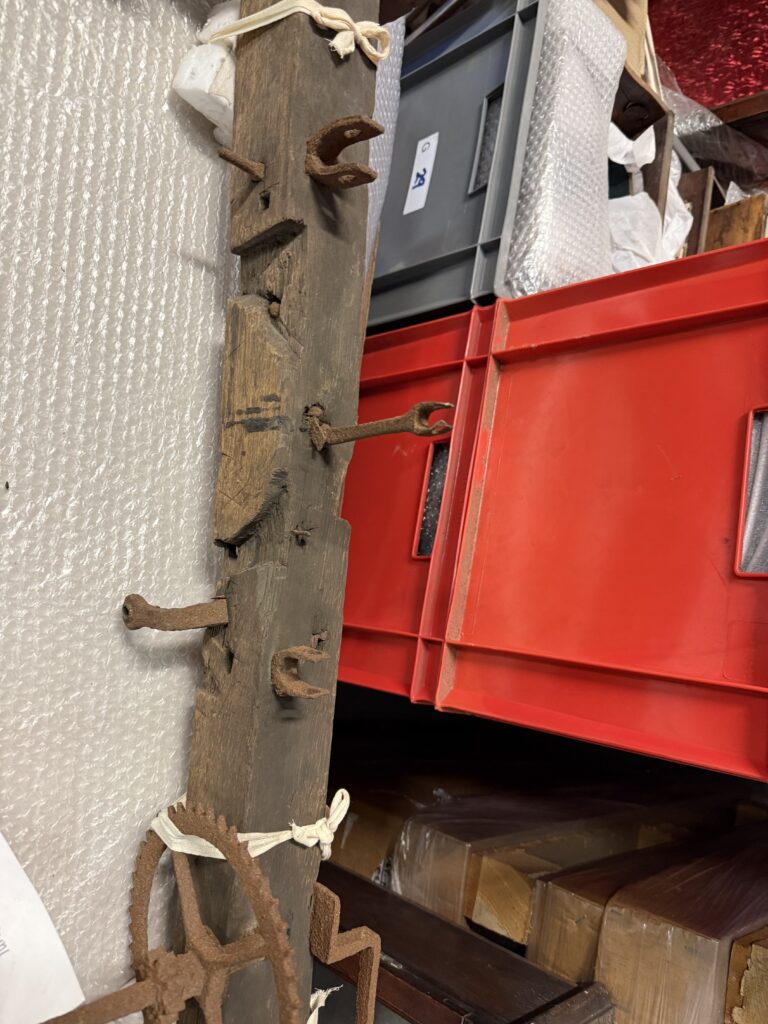
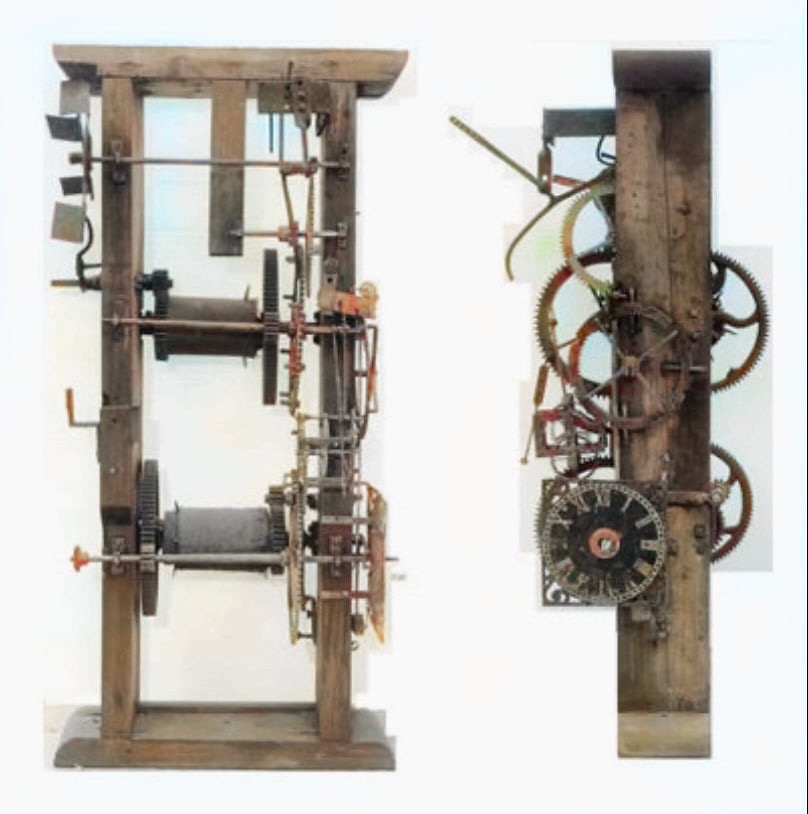
The door frame clock found located in the basement of Hall i’ th’ Wood in the 1970’s remained unrecognised until the research for this site, once thought possibly to be the old Parish Church Clock, it slowly emerged as the original clock from Hall i’th’ Wood
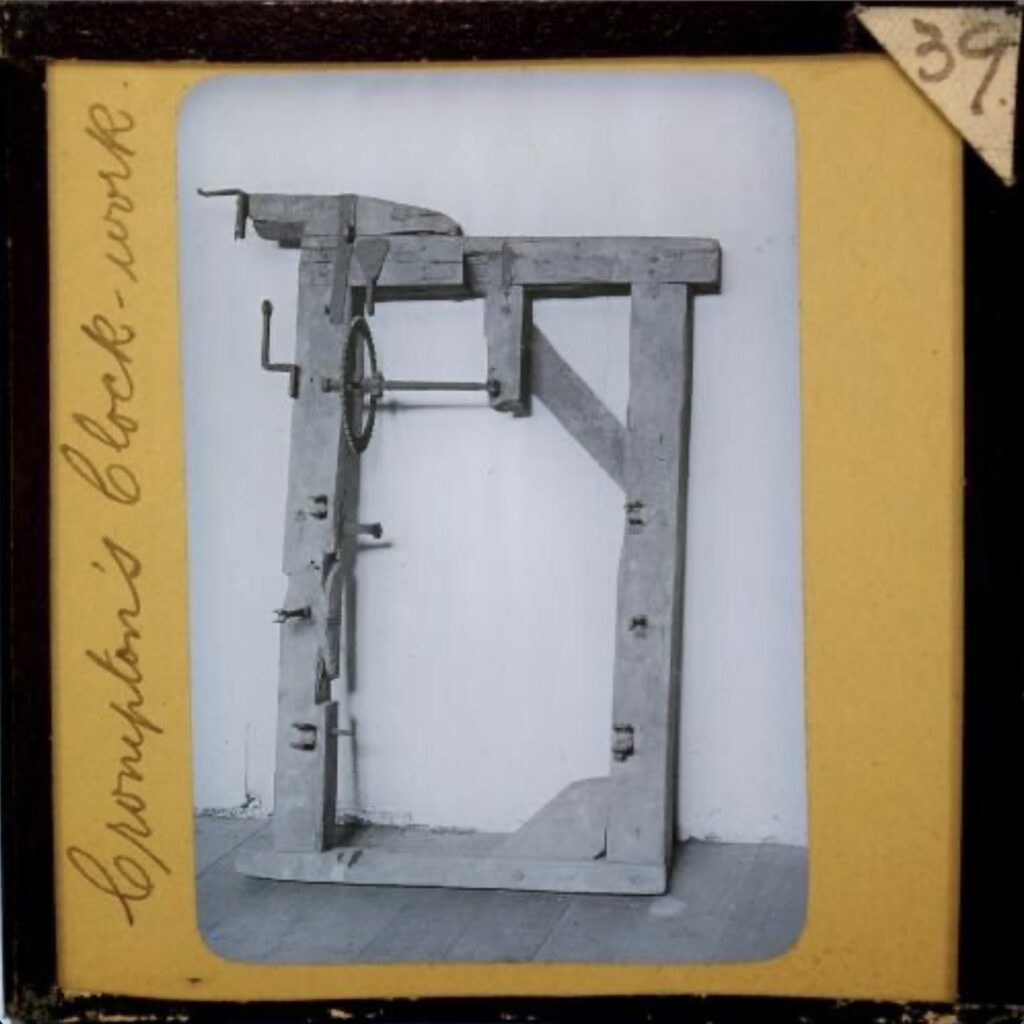
The new word clock eventually replaced the older Old English term dægmæl (“day-measure”). The term ‘clock’ comes from the Latin ‘clocca’, for bell – most of these early timekeepers had no dial at all – and for many centuries after, the term clock specifically referred to a machine which sounded the hours on a bell.
Initially cocks developed for religious buildings were intended only to sound the hours for prayer during the night and during cloudy days when a sundial could not be used, as the use of clocks became more widespread, the primary function for the majority of these early clocks was to provide an audible indication of the time.
A similar and complete clock from Metfield Church, dates to 1551, to show how the Hall i’ th’ Wood clock would have looked in service.
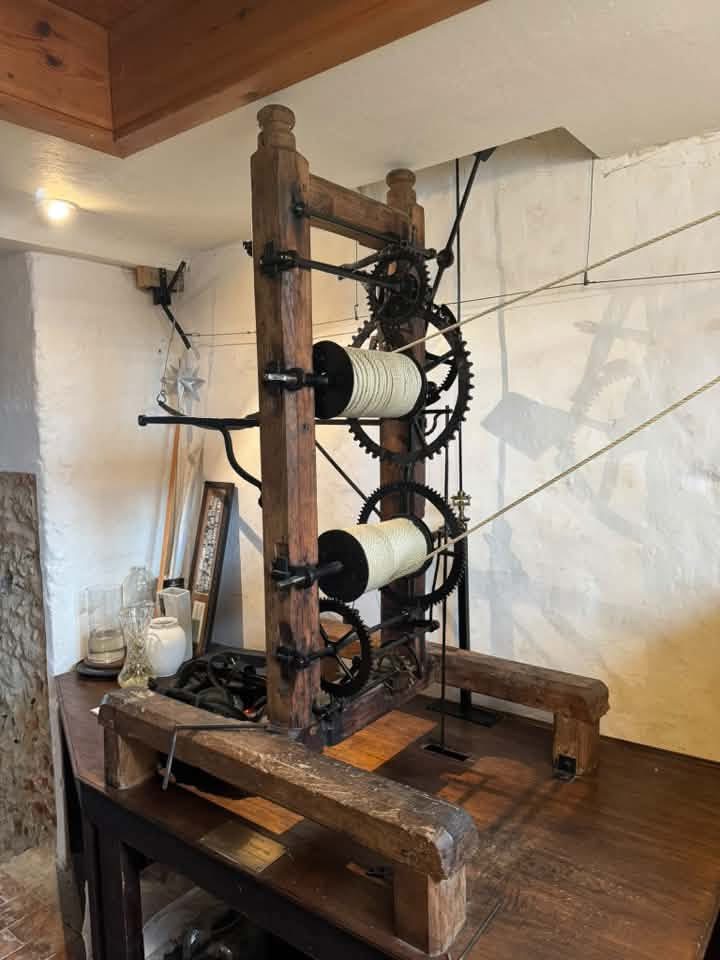
This clock was restored by Hayward Horological Ltd.
Crompton’s Secret Project: Working secretly in his room (dubbed the “conjuring room”) from 1774 to 1779, Crompton combined the best elements of James Hargreaves’ spinning jenny and Richard Arkwright’s water frame. The resulting machine—the spinning mule—could spin incredibly fine, strong cotton yarn at a massive scale.
The Hidden Invention: When the machine-breaking riots swept through Bolton in 1779, the unrest came too close to his home. To protect his years of secret labor, Crompton painstakingly took the prototype apart piece by piece and concealed the wooden and metal components in the ceiling and floorboards of his attic.
Dating the Clock.
Dating clocks of this era is an imprecise science, firstly the type and style, bell striking, without a dial, and of door frame construction, tends to suggest the clock dates before 1600 and an example is shown in the Metfield Church clock.
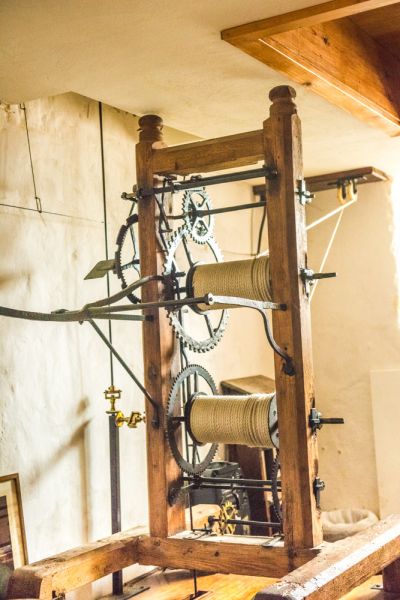
The Metfield clock is documented from 1551, it appears from the format to have had the pivots replaced at some time in its history with saddle bearing caps, as evidenced by the cutouts in the frame.
The change of bearings probably coincided with the upgrade to a pendulum that was completed in 1719.
The design of the pivots, or bearings in the frame of the Hall i’ th’ Wood clock, are a channel with a taper key, rather than a defined bearing block surface, this tends to equate to earlier clocks…
An example is shown here from Castle Rushen in the Isle of Man dates from 1597.
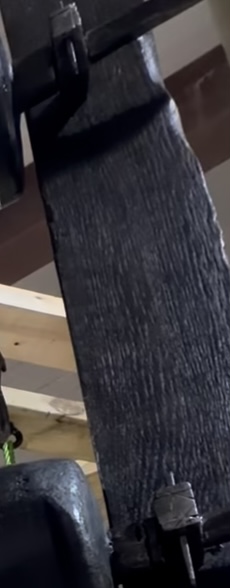
The Castle Rushen clock is documented from 1597 when it was said to have been presented by Queen Elizabeth 1st of England. In the clock room, formally used as the castle chapel lies a clock presented by the Queen, while she held the island in trust pending a dispute. The clock is of simple construction with only one hand, but still keeps very good time.
When compared to the Hall i’th’ Wood clock it bears a remarkable similarity in design and techniques.
Now when dating any early clock there are always similarities and differences, technology take a time to migrate, and local initiatives often are employed by the makers. This makes any date only an estimate.
The estimated date of the clock would be from the late 1500’s to the late 1600’s, but with the expectation that the age would be towards the late 1500’s to the early 1600’s
Late 1500’s, early 1600’s, (1550 – 1625) this would tie into the history of similar clocks, and also of Hall i’ th’ Wood, where in 1590 the stone North West Wing was built by the Norris family.
it could be that the clock was fitted at the time of the upgrade, or may even have been in existence before the upgrade, as part of the original house.
Radio carbon dating predicts good results, but needs a sample and relies on the frame being original, which with these fittings, and the clear history of the Hall I’ th’ Wood clock, the frame is very likely to be, so this may be a good way to determine the clocks real age with some degree of accuracy.
However it should be noted that some later clocks still utilised the wedge bearings alongside saddle bearings, such as this one from the late 1600’s, but if the Hall i’ th’ wood clock was later, it would most probably have been fitted with the much better saddle bearings.
The Church Clock, from Barton in Barton-in-Fabis, Nottinghamshire said to date from 1680 – 1690.
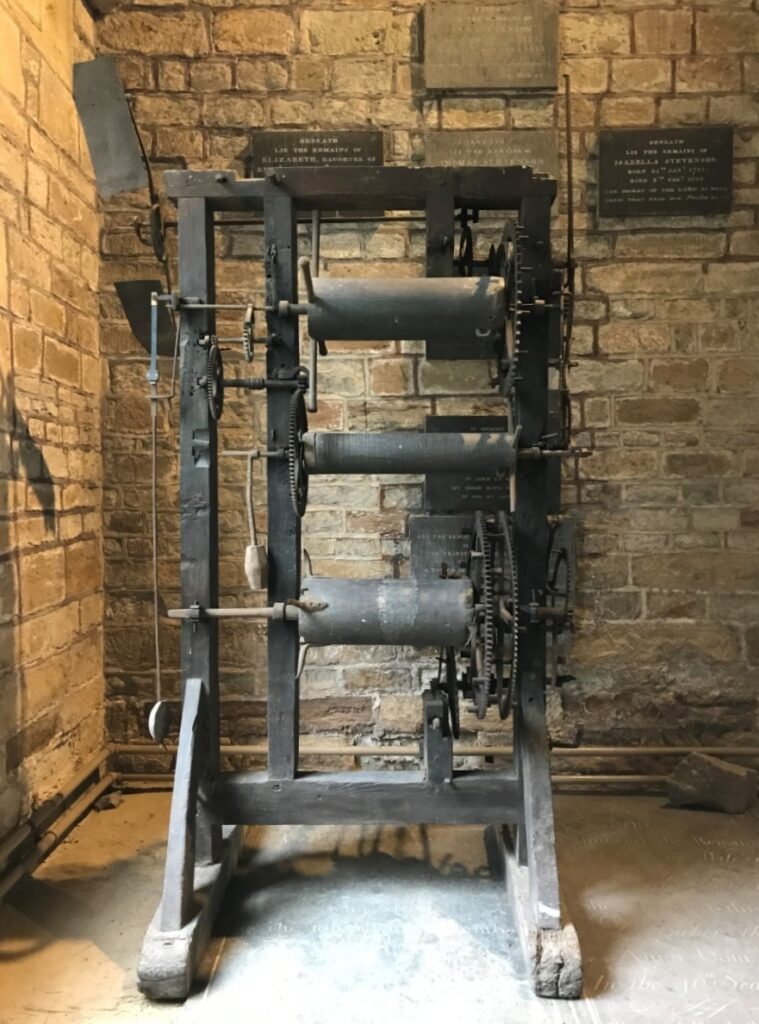
Brindle Parish Church Clock
Brindle Parish Church had a clock made by Boltons own clock maker Thomas Kirkhall in 1637, this later clock has many similarities, but also has updates such as saddle bearings, showing that the technology of the time in Bolton would likely have been applied to this clock had it been made beyond 1637. The Brindle Clock is in Liverpool Museums collection.
Brindle Parish Church Clock
Conclusion:
Whilst the loose clock frame found in the cellar of Hall i’ th’ Wood in the 1970’s drew little interest and remained unidentified and unsuitable to be displayed for fifty years, it was ascribed a number, INV:21901, and a secure place in the Bolton Museum archives.
Never knowing the Hall to have had a clock, and there being no clear evidence of a clock tower, it was just assumed that the hall never had a clock, the presence of that clock and the possibility of a Bell Cot on the roof only became clear with the research of this clock.
Consideration that this could be the long lost Parish Church Clock became a possibility and was explored. During that research it became increasingly clear that rather than to the Parish Clock, which was fitted in the Old Parish Church in 1671 this clock was much older and actually belonged in Hall i’ th’ Wood, and its history was inextricably linked both to Hall i’ th’ Wood, and surprisingly also latterly to one of its more famous residents, Samuel Crompton the inventor of the Spinning Mule.
Crompton hid his Mule from machine breakers in the attic by the clock
The clock would appear to be a part of the original ‘Hall In The Woods’, the Grade One, Half Timber, or Timber Framed and Plaster Building, tracing back to 1483. It is although, with the possible date range for the clock, a possibility that the clock originated concurrently with the Stone Wing built by Alexander Noris, as the clock relates comfortably to the the time of building the stone North West Wing in 1591.
In conclusion, item INV:21901 Turret clock, held in the Bolton Museum Archive is considered to be the original striking clock from Hall I’ th’ Wood, dating from 1550 – 1625, it was fitted in the attic, it had no dial, and as custom at the time, rang a bell in the Bell Cot,
The clock would have been set to local time with a sundial. It is this clock would have been the clock present when Samuel Crompton disassembled his mule and hid it in the attic near the large clock in 1779.
It is assumed that in 1928 following the curator’s report in February which started that the “The roof timbers are badly eaten by the death watch beetle and my Committee is now taking steps to remove or strengthen some of the spars, posts etc.” it was likely that this is when that old clock frame was removed from its location and discarded into the cellar, its not clear when the parts off the movement were lost or robbed out of the frame.
INV:21901 Turret clock – Social History
This means that the clock dating from 1550-1625 is almost certainly, from the era of Elizabeth 1st and is one of the oldest surviving clocks in Lancashire!