Samuel Crompton the Bolton Born inventor of the Spinning Mule had the watch made expressly for him at the cost of five guineas (£5.25) . (The Gold Guinea was a coin that was minted in Great Britain between 1663 and 1814, that contained approximately one-quarter (0.25) of an ounce (approx 7g)of gold.)
The watch was bought by the Bolton inventor in 1779 with the proceeds from his Spinning Mule which helped revolutionise the cotton industry.
Crompton was a regular visitor to the Deansgate shop of watchmaker George Hodson while the watch making was in progress, and he watched the work with some interest and impatience, but once delivered it was to be his constant companion for the next fifty years. Crompton left his treasured Hodson Watch to his James son on his deathbed.
The pair case, verge watch by George Hodson, is now in the Bolton Museum collection.

Crompton died without ever making his fortune, but kept the watch and passed it onto his son.
The watch was photographed and included in a Magic Lantern slide by John Henry Crabtree (1863-1924).
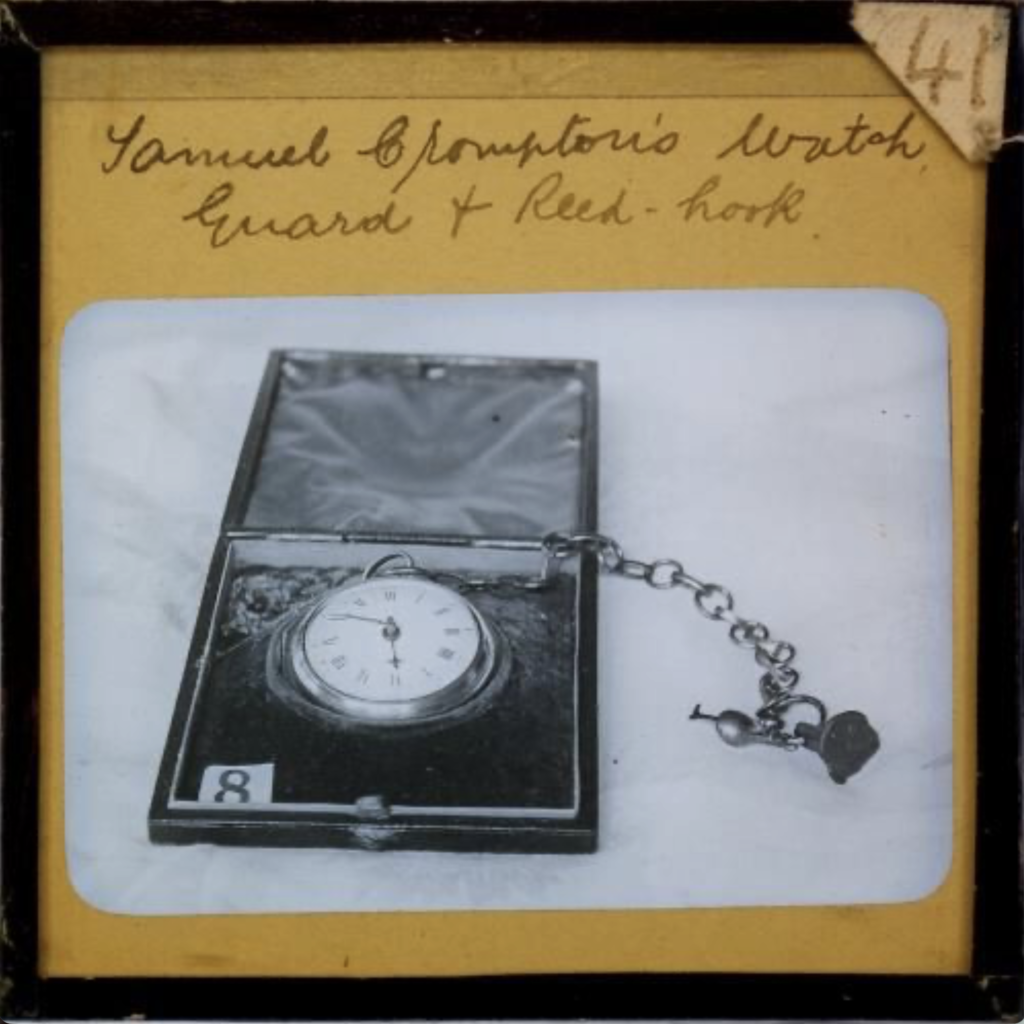
The watch was fitted with Guard and a Reed-hook, the Guard would later become known as an Albert and was the chain which secured the watch.
The Reed Hook is a small, hand-held tool used in weaving to pull individual warp threads through the narrow slits (called “dents”) of a loom’s reed a or a frame with many vertical slits. It is used to separate and space the warp threads, to guide the shuttle’s motion across the loom, and to push the weft threads into place.
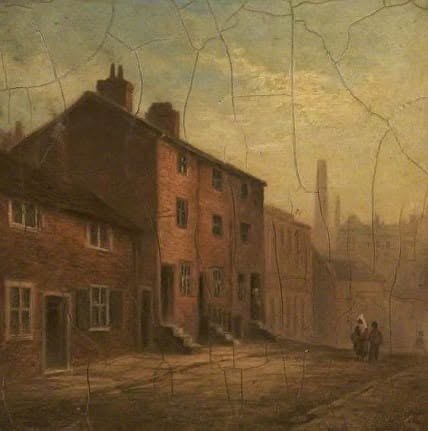
Samuel Crompton lived his latter years in number 17 King Street, where he lived out the end of his life.
Crompton also owned a Long-Case Clock, which also came to be housed in Bolton Museum