During the era of the cotton mills, there was a trend to time production against the day. This resulted in clocks with two dials, one me a singing the actual time, and the other showing the running time of the machinery, showing the stoppages that accumulated during the day.
Note the absence of the One O’Clock mark, this was to allow for the Lunch Hour.
Circa 1840 made by Henry Lawson (1806 – 1854) of Hindley, it would have been directly linked to the machines on the factory floor.
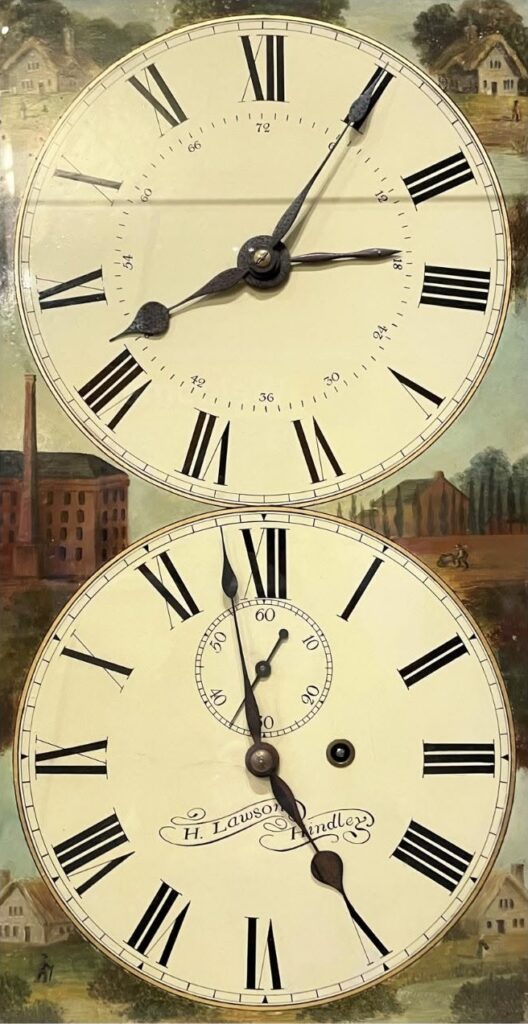
A typical Mill clock of the type that would have been used in some of the cotton mills in Bolton, that in 1929 had 247 cotton mills it is inconceivable that Bolton makers were not engaged to produce such clocks, but sadly the passage of time and the loss of the mills have consigned these unique items to history.
The Lower dial is for actual mean solar time driven by a separate single train and pendulum. Theoretically if the mill had been running at optimum capacity at all times the indicated time for that day would have been correct, and both the upper ‘mill’ and lower ‘time’ dials would be synchronised at the end of the working day. Naturally, in practice, there will have been times when the machinery would have been inoperative (or running slow), hence by the end of the day the ‘mill time’ would have been lagging behind. By recording the difference between the two the amount of ‘running time’ lost would have been obtained.
Generally, it appears that very few ‘mill clocks’ seem to have survived.
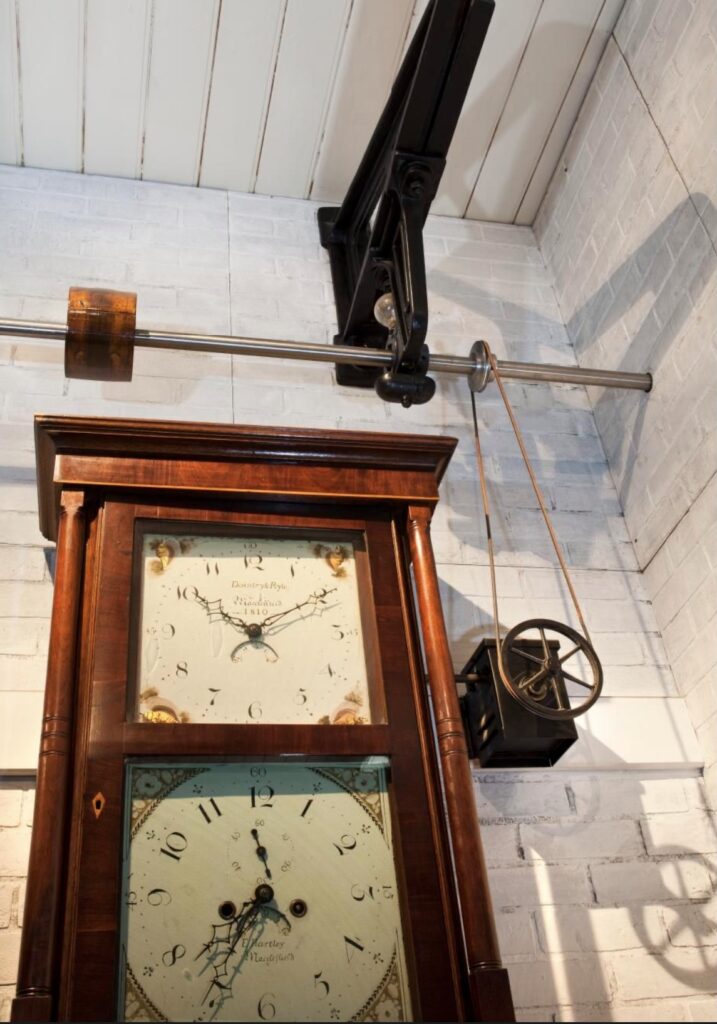
A similar clock connected to a line shaft from the mill.