William Williams a watchmaker and Jeweller is listed as working at 99 Blackburn Street in Radcliffe. He specialised in keyless wound watches. This is where the watch is wound turning the crown, rather than using a separate external key directly inserted into the movement.
William’s held patent No.4762 which was introduced in March 1890, surprisingly a number of makers, including Williams himself, claimed sole use of his patent.
On March 26, 1890 William Williams of Bury received a patent for an escapement that “beats 10, 12 or 16 times per second”. Williams achieved this by adding an extra wheel in the train and placing the escapement wheel next to the seconds hand. He also used a particularly fast balance that was capable of 57,600 beats per hour.
Williams Patent No 4762, March 1890: “Improvements in Stop Watches”.
William’s held patent No.4762 which was introduced in March 1890, surprisingly a number of makers, including Williams himself, and Tailor of Rochdale, claimed sole use of his patent.
From 1880 he was listed at 32 Rock Street, Bury, where adverts from the time suggested the moving of an established business.
William also held several patents in the late 19th century related to chronographs for whippet racing, including patent no. 323 of 1881, and 17506.
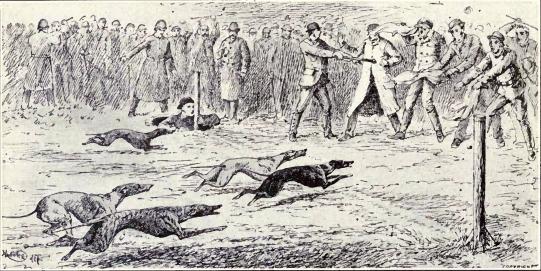
Whippet racing – 200yds in 12.5 seconds
The racing of whippets required precise timing, as they were very fast, the shared covered 200 yards in 12.5 seconds, meaning they covered 1 yard in 1/16th of a second, and so fast running watches became essential before modern stop watches were developed.
William left Bury and established his workshop in Liverpool, where he traded.
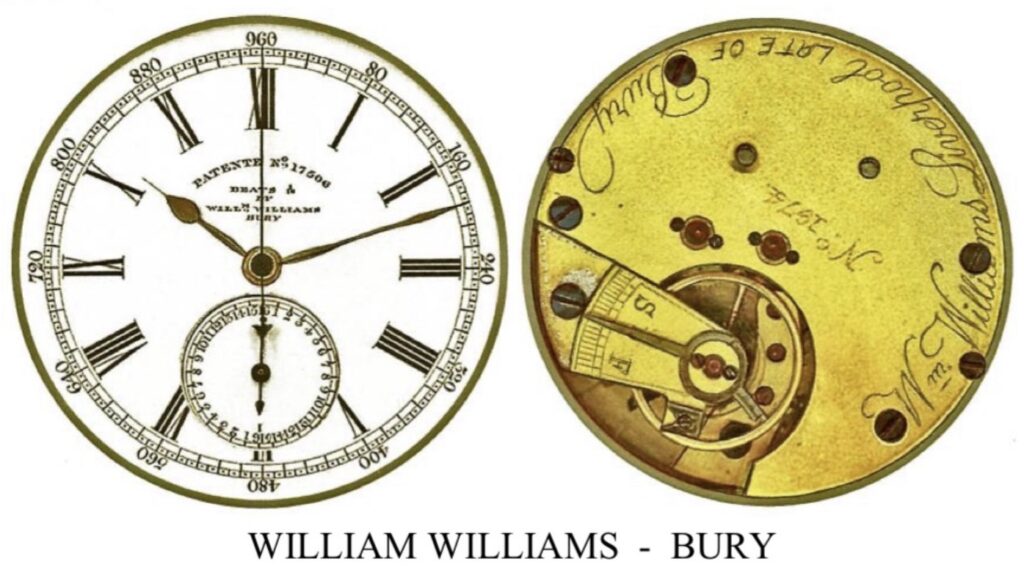
A William Williams watch of 1891, from his times in Liverpool.
Dates:
William Williams from about 1850 in Burlington Street, Liverpool,
William Williams from about 1880 in 32 Rock Street, Bury.
William Williams from August 1880 in 27 Bolton Street, Bury.
William Williams from about 1881 in 99 Blackburn Street, Radcliffe.
William Williams “Late of Bury” from 1891 again in Liverpool.
Patents:
1881 – Patent No. 323 – Registration of 1/8, 1/10 and 1/12 seconds.
1883 – Patent No. 4496 deepened these to 1/16th seconds.
1890 – Patent No. 4762 describes the Fast Train construction.
Issued on 26th March 1890 – English lever escapement, the centre seconds hand mounted directly on the extended arbor of the escape pinion. The balance has a very fast rate of vibration causing the centre seconds hand to rotate once every two seconds in sixteenth seconds divisions. The subsidiary hand rotates as normal once every sixty seconds but travels smoothly, the stopping between impulses not being perceptible. The movement is stopped by a thin piece of wire acting upon the safety roller of the balance. This gives enough impulse to the balance to restart the watch. “
Note:- Patent 4762 he later gave as a license to John Taylor (Junior). Successor of John & Edmund Taylor, Drake Street, his watches are marked, “WILLIAM’S PATENT No. 4762 SOLE MAKER JOHN TAYLOR ROCHDALE.”
1892 – Patent No. 17506 describes new construction with small 1/16 sec bins counter, and a crown winding mechanism.
In 1900 the watch would have cost circa £10-£12, a value today of approximately £1500 – £1800.
The watch is an open face silver hallmarked Chester 1888/89, the case unusually wasn’t made by William, but by Henry green of London, mirroring a trend in the industry of buying in cases rather than making them under your own business.
The ¾ plate centre seconds fusee with the Williams Fast beating escapement serial number 1818, utilises a six wheel train, the Sith wheel providing the arbour for the subsidiary seconds dial, which is graduated into the 1/16th seconds, and makes a full revolution every two seconds. The start stop function works on the balance staff.
The white dial has roman numerals for hour markers and an outer ring divided into seconds and ¼ seconds running in sets of 80 around the circumference.
The watch is linked to Cambridge and its owner Robert Frederick Hinson, who was linked to the Cambridge Town Rowing Club.


William Williams watch of 1890 when his store and workshop were based at 99 Blackburn Street in Radcliffe.